Table of Contents
SEO traffic is often treated as the primary driver of B2B growth. Businesses invest in content, rankings improve, and organic traffic starts increasing. On the surface, everything looks like it is working.
But in many cases, growth stops there.
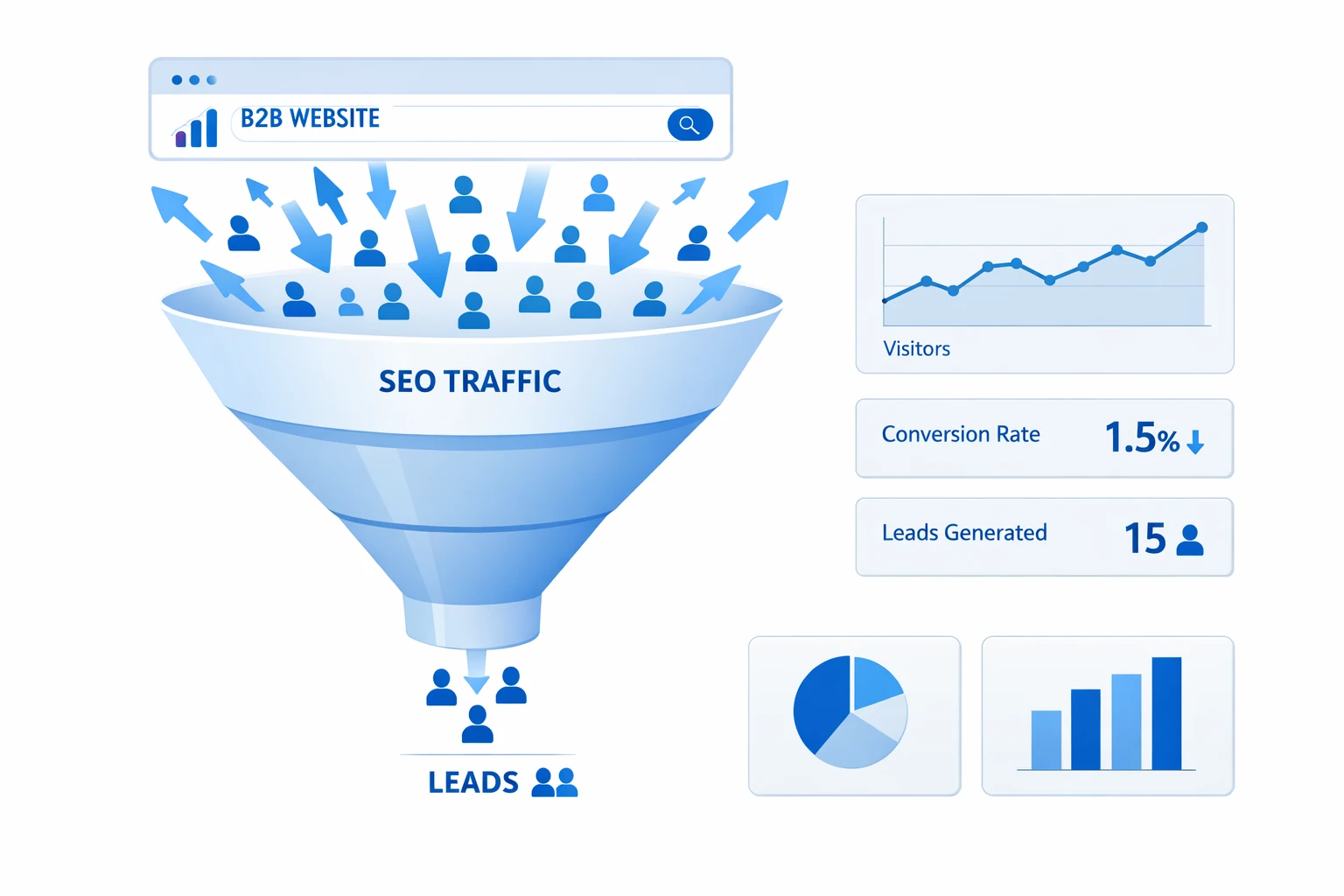
Traffic grows. Leads do not.
This gap highlights an important reality. SEO traffic contributes to B2B growth, but it does not complete it. Without a structured approach to conversion and intent alignment, SEO traffic becomes visibility without business impact.
What SEO Traffic Actually Contributes to B2B Growth
SEO traffic plays a clear role in the early stages of the B2B journey. It helps businesses get discovered by the right audience and builds long-term visibility.
Key contributions of SEO traffic include:
- Increasing organic visibility across search engines
- Bringing consistent inbound traffic
- Building authority through content
- Supporting awareness and education
In B2B growth, this stage is critical. Buyers often begin with research. They look for insights, comparisons, and solutions to their problems.
SEO traffic ensures your business appears during this phase.
However, appearing is not the same as converting.
The Limits of SEO Traffic in B2B Growth
SEO traffic has structural limitations that prevent it from directly generating leads or revenue.
Traffic Does Not Equal Buyer Intent
A large portion of SEO traffic comes from informational queries. These users are exploring topics, not making decisions.
Common traffic types include:
- Educational searches
- Industry research
- General problem awareness
This creates a mismatch between traffic volume and business outcomes. High traffic does not always mean high-quality leads.
SEO Traffic Does Not Provide Conversion Direction
SEO brings users to a page, but it does not guide them further.
Without a clear path, users:
- Read content
- Leave the website
- Do not take action
Common gaps include:
- No defined next step
- Weak or generic calls to action
- Lack of internal navigation toward services
This results in traffic that does not move forward in the funnel.
B2B Growth Requires Trust and Nurturing
B2B decisions are rarely immediate. They involve:
- Multiple stakeholders
- Budget considerations
- Risk evaluation
SEO traffic alone cannot build trust at the required level.
What is often missing:
- Case studies
- Proof of results
- Clear positioning
Without these elements, traffic does not convert into qualified opportunities.
SEO Traffic Attracts Mixed Audience Quality
Not every visitor is a potential client.
SEO traffic typically includes:
- Students and learners
- Competitors researching the market
- Low-intent visitors
This reduces the overall efficiency of organic traffic as a lead source.
SEO Traffic vs B2B Growth Outcomes
The difference between traffic and actual growth becomes clearer when compared directly.
| Factor | SEO Traffic Focus | B2B Growth Focus |
|---|---|---|
| Goal | Increase visitors | Generate qualified leads |
| Intent | Mixed audience | High-intent buyers |
| Content Type | Informational | Decision-driven |
| Success Metric | Traffic and rankings | Leads and revenue |
| User Journey | Entry point | Full funnel |
This table highlights a key point. SEO traffic is only one part of a larger system required for B2B growth.
Where SEO Traffic Fails Without a System
When SEO operates in isolation, it creates gaps that limit business outcomes.
These gaps include:
- Traffic without lead capture
- Content without strategic direction
- Visitors without engagement
- Rankings without revenue
In many cases, websites are optimized for search engines but not for users.
Typical signs of failure:
- High traffic but low conversions
- Low time on key pages
- No clear funnel structure
- Minimal inquiry or contact activity
These are not SEO problems. They are system problems.
Turning SEO Traffic Into B2B Growth
To move from traffic to results, SEO must be integrated into a structured growth approach.
1. Align SEO Traffic With Intent
Focus on keywords that reflect real business needs.
Examples:
- Informational: broad and early-stage
- Commercial: solution-focused and high intent
Prioritizing intent ensures that SEO traffic includes potential buyers, not just visitors.
2. Build Conversion-Focused Pages
Every page should guide the user toward an action.
Essential elements include:
- Clear value proposition
- Defined audience targeting
- Strong and visible calls to action
This creates direction within the user journey.
3. Use Internal Linking Strategically
SEO traffic should not stop at a single page.
Guide users through:
- Related blog content
- Service pages
- Case studies
Internal linking transforms isolated visits into a structured experience.
4. Add Trust Signals Across the Website
Trust is a major factor in B2B growth.
Include:
- Results and performance data
- Client examples
- Visual proof such as dashboards or reports
These elements reduce friction in decision-making.
5. Create a Simple Funnel From SEO Traffic
Instead of a direct jump from visitor to contact page, structure the journey.
A basic flow:
- SEO content
- Value-driven insights
- Internal navigation
- Clear action point
This increases the likelihood of conversion.
SEO as Part of a B2B Growth System
SEO traffic should be viewed as the entry point, not the entire strategy.
A complete B2B growth system includes:
- Traffic generation through SEO
- Messaging that aligns with business goals
- Funnel structure that guides users
- Conversion mechanisms that capture leads
SEO supports growth, but it does not replace these components.
When combined, these elements create a system where traffic contributes directly to business outcomes.
Conclusion
SEO traffic remains an essential component of B2B growth. It brings visibility, consistency, and access to potential buyers.
However, its limits are clear.
Traffic alone does not generate leads. It does not build trust. It does not guide users toward decisions.
Real B2B growth happens when SEO traffic is integrated into a structured system that aligns intent, builds credibility, and drives action.
Businesses that recognize this move beyond traffic metrics and focus on outcomes that matter.